
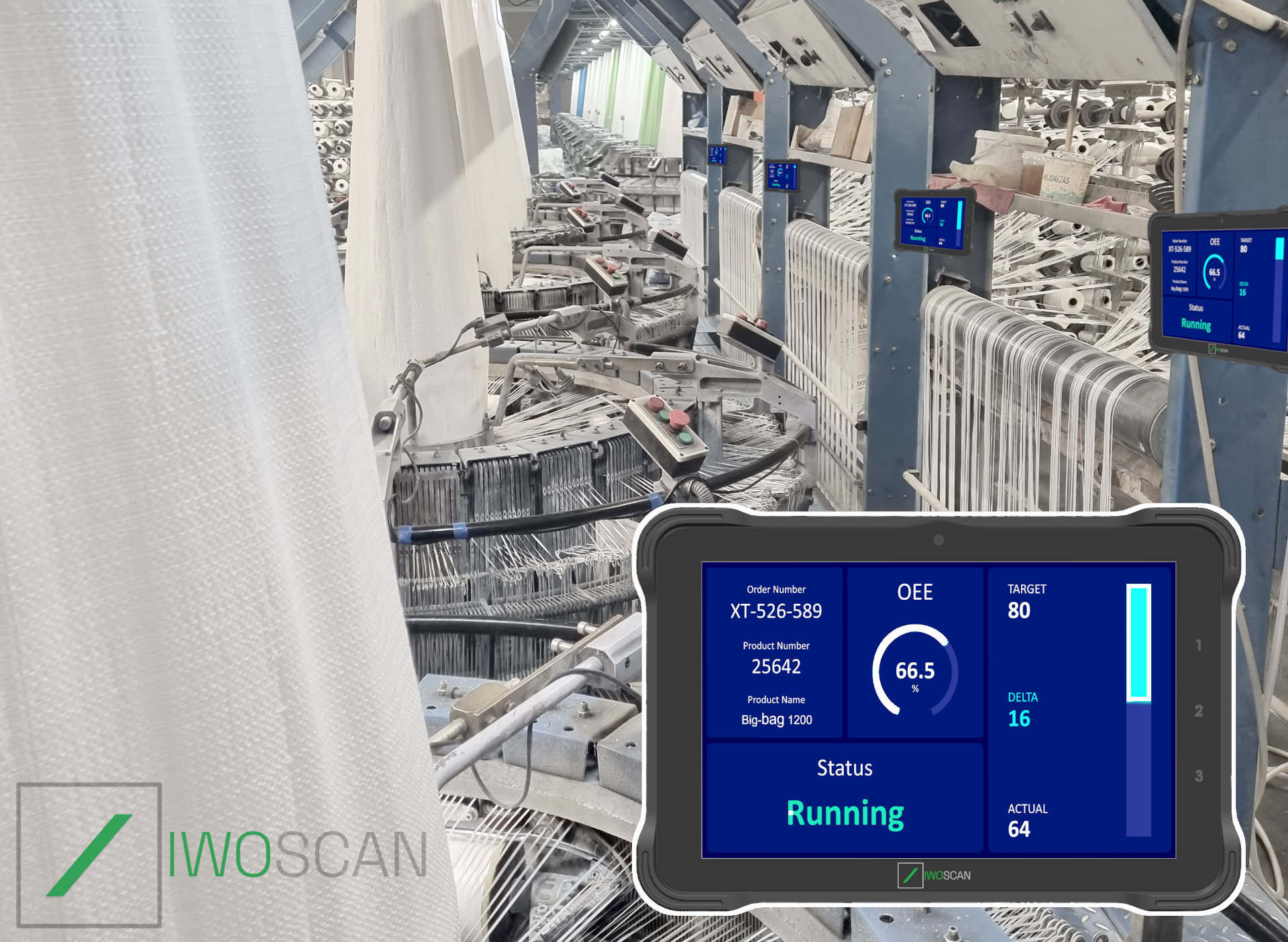
Manufacturing data collection
Why does DIY data collection in production usually fail?
Every production manager expects accurate and clear data from the shop floor, but in reality this result is not always easy to achieve. Trying to perform analysis without a reliable primary data source quickly turns into sets of numbers that are difficult to interpret. The rule is simple: if a process cannot be measured accurately, it cannot be improved consistently.
Why does everything look simple at the beginning?
The classic situation starts quite logically. The manager and production team agree that the shop floor needs more transparency. Nobody likes arguing with operators without a real basis or making decisions based only on the phrase “it seems so to me”.
After deciding to digitalize, companies often turn to the IT department: “Make it, design it, program it.” At first glance the task looks straightforward: buy a sensor, connect it to a Raspberry Pi, Arduino or ESP32, send the data to a server and then, it seems, all that remains is to show nice charts.
The problem is that in production the signal alone is not enough. Context matters: what was being produced at that moment, which task was running, who was working, whether the machine was really producing, or whether setup, adjustment, waiting or a short technical pause was taking place.
How does such a project usually develop?
- After 2-3 weeks a microcontroller or small computer is already connected to the equipment. The first technical result looks promising.
- After one month the system sends the first data to the server. The team waits for more data to accumulate so analysis can begin.
- After 3 months and several corrections, there is already a more stable set of data covering a few weeks. It feels as if the hardest part has been solved.
- Then the production manager asks: “How do we know what exactly we were producing at that time?” The team starts thinking about links with tasks, orders, employees and products.
- After 6-12 months it becomes clear that one report is not enough. A whole system is needed: administration, queries, statuses, downtime causes, user permissions and historical data management.
This is not poor work by the IT team. In most cases, the amount of production logic hidden behind one simple signal is simply underestimated.
What becomes visible later?
If there is enough persistence and energy, the project can continue. It may even be possible to connect ten high-cycle workstations. That is already a serious team achievement, but after longer data accumulation, new questions often appear.
- Generating one report takes a very long time because the amount of data has grown faster than planned.
- Technical inaccuracies appear in the data, consistency is missing and it is not always clear why it happened.
- A classic SQL structure is not always convenient for intensive, sequential streams of production events.
- Real-time analysis becomes increasingly difficult to achieve, even though it is exactly what is needed most during a shift.
In practice, many companies that tried to build production data collection from scratch go through a very similar cycle. Some projects fade out, while others keep working but require constant IT attention and continuous additions.
Valuable experience, but it costs time
The DIY path can be useful as a learning process. The company understands its processes better, sees where data is missing and defines its needs more clearly. But practical learning in production costs time, IT resources and management attention.
- A company can spend from half a year to several years before it reliably solves the basic questions of data collection.
- During that time, resources are used to build infrastructure, although they could be directed to increasing actual production capacity.
- When, after such experience, a company chooses a ready-made solution, the conversation usually becomes very specific: it is already clear what data is needed and where the real problems are.
Why is one sensor not enough?
One isolated signal almost never shows the full production picture. The equipment may be running empty, being adjusted, waiting for raw material or performing technological preparation, while the sensor still records that “something is happening”. This is not an error. It is simply the nature of the production process.
When several sensors are connected without common logic, the result is often not a clear system but several weakly related charts. For data to be useful to a manager, it must be linked with the task, employee, workstation, product, downtime cause and process status.
How does IwoScan solve this problem?
IwoScan is based not on one isolated point, but on integrated production logic. The system combines signals from several related process points: automated equipment, manual work areas, RFID or BAR/QR registration, tasks and operator actions.
- Objectivity and accuracy. A logical chain of several points reduces the risk of incorrect interpretation and helps distinguish production from setup, waiting or a technical pause.
- Simpler cause classification. Operators do not need to manually track every small stop. The system records the event automatically, and the employee only needs to specify the cause with a few clicks or by scanning a code.
- Unified data. Information at the workstation, on the manager screen and in reports matches in real time, so there are fewer arguments about different numbers.
“ATTENTION” status before the line stops
Many systems work as end-of-day reporting tools: they show how much downtime has already happened. That is useful, but it is information about the past.
Because IwoScan works in real time and first processes data in the local system, the production team can react earlier. If algorithms detect that the flow is starting to jam or slow down, a warning can appear on a screen or industrial signal light: “ATTENTION, in XX seconds it will be BAD”.
Such a warning gives the operator or shift supervisor several important seconds or minutes. Sometimes that is enough to refill components, move the flow of parts, adjust the action sequence and avoid the downtime domino effect, where one small flow disruption later spreads across the entire line as continuously increasing downtime.
Summary
Reliable manufacturing data collection starts not with a beautiful chart, but with a correct understanding of the event at the workstation. A ready-made solution helps avoid long experiments, obtain reliable primary data faster and make decisions based on facts instead of guesses.
IwoScan can be integrated with existing business management, accounting or production planning systems, for example Odoo. The system helps employees fill in less information by hand, gives managers a real view of the situation and helps production work in a more stable rhythm.