
Sensors and motion control
Position or rotation angle sensors: encoders
Position sensors are used to determine the position and speed of a motor, shaft or another rotating mechanism. They allow the control system to see movement accurately and react to the real mechanical state.
How does an encoder work?
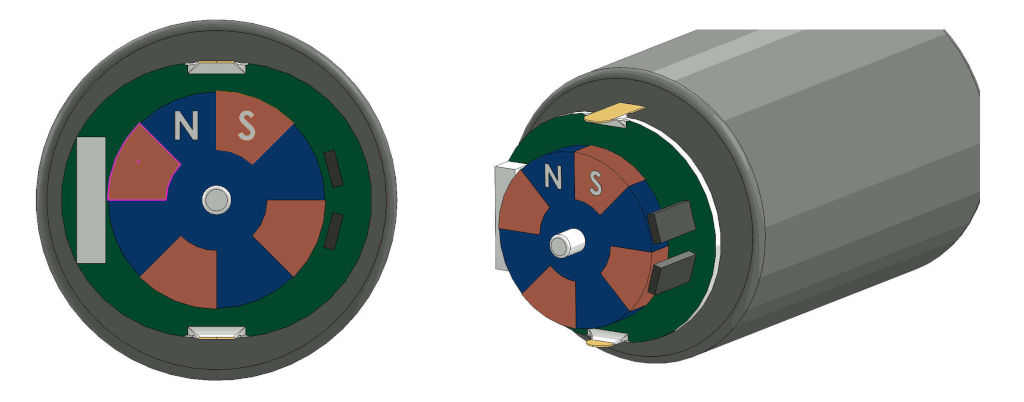
Encoders are rotary coding devices. They use magnetic or optical sensors that detect changes in the magnetic field of a rotating magnetized wheel or optical pulses from a perforated disk.
Position information is usually read through two channels: A and B. The encoder forms a two-phase square-wave signal, known as a quadrature encoder signal. The phase shift between channels A and B is usually about 90 degrees.
What can be determined from A and B signals?
- Rotation direction, because the phase sequence of A and B changes depending on direction.
- Movement speed, by measuring pulse frequency over a selected time.
- Position change, by counting pulses from the starting point.
- Control system response accuracy when an encoder with sufficient resolution is used.
Where is this used?
These sensors are used in CNC machines, industrial automation, servo drives, conveying systems, printing and packaging equipment. They are especially important when a motor must not only be switched on, but its position, speed and movement accuracy must also be controlled.
When choosing an encoder, it is important to evaluate mechanical mounting, pulses per revolution, signal level, supply voltage, protection rating and environmental conditions.
Practical advice
If a machine starts positioning inaccurately, it is worth checking not only the encoder itself, but also cables, shielding, connectors and signal quality at the controller input.